Sunday, June 19, 2016

Italy and America: A comparison of cultures

So, I've been back in the United States for over a week.   And it's been a rather busy week.  I've moved back into Boston, then moved right back out to my home town of Honeoye Falls, NY.  In this time I've noticed some striking differences between US and Italian cultures, but ultimately, I think there is more similar than different.

White Oak Barrel in Mt. Vesuvius volcanic cave
We all know the Italian stereotypes.  The food, wine, and life lovers who eat long meals and work short hours.  But I've learned Italians are an incredibly hard working people.  In every city we went to there were shops for food, coffee, or knick-knacks on every street.  On top of that there were several people peddling posters, whirly gigs which could be flung up into the air with a rubber band, and laser pointers.  The Italians I met on the vineyard on Mt. Vesuvius were very kind and also a very hard working family.  They were able to cater a group of twenty-eight for a couple of hours, while we were all running a little late for the next event.  That is on top of running the farm, the fermenting and aging products, and the bottling and sale of their product.  I've also learned that there is a long and strong history of family business in Italy.  The Ducati factory that we visited was all the product of the business founded by three brothers.  And several businesses are owned and managed by one to three people.

Geocentric Model at Galileo Museum
It seems to me that events that reinforce a stereotype stick in your mind longer, while events that work against that stereotype are ignored.  While I was in Italy there were a couple of rail strikes, and several shops closed for lunch, or earlier hours than we would be used to in the United States.  Added to this is the fact that youth unemployment is roughly 37 percent, down from the mid-forties in 2014, but still higher than it has been historically, which was about 27 percent unemployment according to tradingeconomist.com .  But on the whole I would say Italians are no more lazy then Americans, who pride themselves on their "protestant work ethic".  And through my time in Italy I was able to see a strong commitment to the advancement of both science and the arts.

One area where Italian culture diverges from US is food.  In the US I think food is best characterized as a necessity.  Food in America is cheap, filling, and made more tasty through artificial flavors.  Of course there are exceptions, everywhere in the US has regional dishes.  Back home in Rochester there is famous dish called the "Garbage Plate" which consists of macaroni salad, potatoes, hamburger meat, and hot sauce.  This dish is treated with far less reverence than most foods in Italian cuisine.  In Italy there are cheeses whose methods are still made in the traditional style, dating back to the middle ages.  Italy has such a strong history with meats, cheeses, and wine that its government protects the naming rights of these products, and the existence of such geological branding is a source of constant consternation when negotiating trade deals.  Italy's attitude toward food is so strong that its a matter of international importance.

A McDonald's in Venice
Italy's food culture seems to be changing pretty quickly though.  I'm not going to make a value judgement on these changes, but with an increase in tourism, and the reach of international corporations, more efficient food choices are available on Italian streets.  I ate at a McDonald's in Venice, and Milan is acquiring a Starbucks in the coming year.  New experimental wines, like the "super tuscans" perform successfully in markets even though they break with traditional wine making methods.

Milan business district
Italian culture as a whole is experiencing a deep change too.  I noticed several people of African descent in the streets of Italy, and cities like Milan, which hosted the World Expo in 2015 have started looking to the future, and it is apparent in its architecture.  Much like the large American cities, Milan is building large glass skyscrapers.  And more and more Italians are learning to speak English fluently.  Several signs are written in both English and Italian, some in just English.  Italy, like a lot of the rest of the world is undergoing an Americanization.  Much like how cities in France and Spain were strongly influenced by Rome, the difference being that the United States never conquered Italy through force.

But now I'm back in the United States.  I'm sitting at the home I grew up in, in upstate New York.  And soon enough I will move across the country to Silicon Valley, California.  I wonder what, if anything in America should be more like Italy.  More relaxed alcohol laws would top some of my friends lists.  But I think the top of my list would be a greater appreciation for rail transport.  I deeply envy the ability for Italians to move between the major cities faster than highway speeds without needing to go through an airport.  If I could change a second thing I'd want the food culture in America to change.  I'd like more focus on quality than quantity and efficiency.  Americans are on the move, people in the US are more likely to move far away for school or for work, and there is less opportunity to create regional dishes.  It is hard, if not impossible.  But part of the reason why Italy was so interesting was because of its diversity from city to city.  All while it was able to stay under the flag of Italy, and not look out of place.

While I'm sad to leave Italy, I believe I'll always feel more at home in the United States, the Garbage Plate and all.
The infamous Garbage Plate

Thursday, June 9, 2016

More like Ve-NICE

Well, my time in Italy is basically over.  These past weeks have seemed like the just blew by.  The perception of the passage of time is anything but constant.  The weather the past few days has been a little down.  But it's fitting that it's been so wet in a city that sits upon the water.

There is no other city like venice in the world.  Sure, other cities have canals running though them, but Venice is a city of canals.  There are no cars, no bikes, the only motor vehicles are in the water.  And it's been that way for hundreds of years.  That's not to say Venice isn't a very different city to what it historically was.  It's been transformed to almost exclusively a tourist destination.  There are very few actual residents of Venice, and even fewer who don't work in an industry directly linked to tourism.

The first days in Venice were actually really nice, I may not have been fair to the climate here.  We hopped off the train onto Venice, the only land connection to the outside world, and set off to explore the city.


Venice really is a pretty small city.  It's confined by the size of the island, and it can't really build up because it's on a swamp.  And tall buildings would ruin the allure of the city.  Though when taking heavy luggage places it is better to take public transportation, rather than walking.  The vaporettos are medium sized boats which navigate the broader canals of venice to move people place to place.  When people think of Venice they certainly think of the Gondola's, and their drivers in straw hats and stripped shirts.  And there are certainly plenty of those in Venice.  But the service runs upwards of 80 Euros, so I decided against using onef this trip.  Maybe next time Venice.


Please excuse the HDR halo
Venice is a city dotted by buildings with neat architecture and monuments.  Part of the charm of some of the buildings is that most of them have entrances from the water.  But there is also the fact that the buildings look old, damaged by time and salt creeping under the plaster from the canals and the air.  Decorated wells are all around Venice.  They were originally used to collect rain water to drink.  None of the wells are in active use, as the city has drinking water brought in an aqueduct along the train tracks.  The canals were used for sewers at the time, so it was not a good idea to drink from them.

One might wonder how Venice was able to not die from horrible disease.  Part of it was that they did.  Venice was a very unsanitary city for a long time.  Napoleon, when he invaded had to do some very basic things to make sure the city wasn't so pestilent, like start a hospital and make sure the Venetians didn't bury their dead on Venice.  But that wasn't all.  The tides were able to keep the canals relatively clean.  And this is relative to a literal cesspool.  An odd smell still permeates the streets of Venice, and it is still a very bad idea to swim in the canals.

There is, of course, the issue of rising sea levels in Venice.  They even had to raise up the road to prevent damage, and unwalkability of the walkways during High Water.  To manage this issue, Italy brought in a bunch of Dutch guys (because who knows dams and levees better than the Dutch?) to construct a series of 4 barriers, which guard against high tides, with the ability to withstand water up to 3 m (10 ft) above normal water level.  The segments of the Mose Dam rest on the bed of the mouth of the lagoon and allow water exchange.  In the event of high water the segments empty out ballasts and revolve around a hinge to block the water from flooding the city.

While Venice is the most notable city of the Venetian Lagoon, there are several other islands that I was able to explore.  Murano is famous for it's glass.  I was able to watch some craftsmen in the process of creating a glass chandelier.  Something they would probably be able to sell for several thousand dollars.

Borano is a small island, with little of note, except for a leaning bell tower, and several small houses, none larger than 3 stories, which are painted any color you can imagine.  Lido was the last Island I visited, and that place has a beach.  I was able to dip my feat into the Adriatic and feel sand run through my fingers.  It was genuinely a good time and I had a lot of fun.  Up until the rain started.

And it rained a lot after that, and I don't really think it stopped until a few hours ago.  I climbed the bell tower in St Mark's square.  It was cold and wet and rainy, but I imagine when the weather's not aweful I would have enjoyed it more, I did go out for dinner, and I got to see something rare.  A time when St. Mark's was practically empty.  The sky was dark and the lights were on, reflecting on the puddles.  It looked something like a dream.


Goodbye Italy, you will be missed.

Sunday, June 5, 2016

Retrospective: Mt. Vesuvius

In the south of Italy, near the edge of Naples there is a very famous mountain.  It isn't especially large, but it has a history.  And in case you haven't guessed by the title of this post, that mountain is none other than Mt. Vesuvius.
Vesuvius erupted, famously in 79 AD.  The Roman Empire was near its most powerful, and the Emperor Titus had just succeeded his father, Vespasian.  When he heard news of the eruption, the Emperor sent down a fleet of the Roman navy to assist evacuation of the port city of Pompeii.  The famed Roman natural philosopher Pliny the Younger witnessed the event, and Pliny the Elder met his fate trying to rescue people.  They are part of the reason that eruption was remembered so well even so many years after the fact.  But the port town of Herculaneum, referred to as Ercolono by the native population, was also hurt by the eruption.

There is an archaeological site with an excavated Roman town, that you can get a good sense of Roman life, and how the eruption of Vesuvius caused a trail of death and destruction.  People crowded near the docks to escape the pyroclastic flow, but it wasn't enough to save them.  We have no records from any survivors of Herculaneum.  The excavation sites at Pompeii and Herculaneum give us a large portion of our knowledge of life outside the city of Rome during this time, including how Roman towns were organized, and how Roman villas were decorated.

When the Greeks settled Neapolis (Naples), and later Romans founded more settlements around Vesuvius there was no indication that it was a volcano.  Geological evidence suggests that the last eruption before the one in 79 AD was 300 years prior.  The volcano entered into a period of great activity, then settled down until the 1660, where it erupted again quite violently, and since then there have been eruptions every few dozen years. The last one being in 1944, as the allies were retaking Italy in WWII.  So we might be due for another eruption soon, or that may have been the last one for another few hundred years yet.  The eruptions of volcanoes are notoriously hard to predict. Vesuvius is monitored extensively, and the Italian government had put in place economic incentives to move away from Vesuvius.  It is very much an active volcano.


This is an image of the caldera, or crater of the volcano.  Imagine those high cliffs continue around in a circle, I am taking this picture from the opposite cliff.  In certain areas of the volcano there are vents where moisture escapes and it smells of sulfur, imagine rotten eggs.  The hike itself was steep, but once you reached the rim it flattened out.

After the hike around Vesuvius our bus driver skillfully navigated the narrow and winding roads around Naples and took us to a farm to eat lunch.  We ate outdoors, and the owners of the establishment had a few cats, and several kittens, all so young they could barely walk.  What we ate was all local to the Naples area, or that farm itself, and all delicious.  The owner shared with us some olive oil, made from olives grown on his property.  And I bought a bottle of wine, grown from the owners grapes, fermented on site, and aged four years in oak barrels in a naturally formed cave on the side of Vesuvius.  Some of the best wine I've had, and it was only 8 euro. The volcanic soil makes the land very fertile, but it should be remembered that there is an ever present risk, living next to an active volcano.

Saturday, June 4, 2016

Something Old, Something New


Today was another day of adventure, it was an unstructured day, yet filled with several activities done.  Starting off, well starting off was pretty late given that today was the first day in a very long time I was able to sleep in.  I relished the opportunity.  After a quick breakfast I went out with a couple of guys to go into the city to climb the Duomo.  I didn't really have too much in mind as far as what to do after that.

This adventure, like all good adventures, has more than one character.  Calvin and Quan were with me the entire day.  In fact, it was their idea to climb the Duomo in the first place.

And when you don't have a well formed plan, what plan you do have is liable to change.  Went down to the Duomo easy enough, but as it turns out you need to get tickets to climb up the tower, and we just so happened to stumble upon our chaperons in the line.  The combined ticket to go inside the church, and also climb to the top weren't much more expensive than the tickets just to climb to the top, so we got the former, and I got my first experience of the inside of a Gothic cathedral.  The columns stood like tree trunks, and the ceiling was vaulted, drawing your attention up.  All of the windows were stain glass and depicted scenes from the bible.  And behind the altar there were three walls worth of stained glass murals.

After the inside of the Church, which also included a crypt, and medieval ruin dig site, Quan, Calvin, and I climbed to the top of the building.  I wouldn't hesitate in saying the beauty of the exterior matches the beauty of the interior.  And the skyline is possibly the most interesting in all of Italy, possibly because of the modern structures in the background.
 
Those buildings, following Quan's suggestion is where we walked next.  By this time, having left around 2 in the afternoon, it was already encroaching upon the evening, and I was ready to go back.   These blog posts don't write themselves ;)  But I decided to keep going, because hey, what's a blog without things to write about?

The business district, in Porta Nuova had architecture beyond what I've ever seen.  There was a building with a tall spire which curled up like a rolled up piece of paper.  There were other buildings with trees growing all over them.  Unfortunately, by this point it had started to rain, and though it started as a light trickle, it morphed into a raging thunderstorm.  I recall saying "If this were a movie, you'd expect something bad to happen next."  And unfortunately (for the story)  nothing did.

By 7:30 the rain was still coming down hard, but we were getting pretty hungry.  We were stuck in Garibaldi train station, because that was where we took shelter from the rain, but we decided to look for dinner.  I found a cool place on TripAdvisor, and we ran there, from the train station.  By the time we got to the restaurant, only a few blocks away, we were sopping wet.  But the warm food was very welcome.  And I swear, the minute we sat down to eat, the rain stopped.

By the end of the meal it was getting pretty late by our reckoning and it was time to go home, but we didn't.  Quan really wanted to find a gelato place, that wasn't exactly nearby.  But we walked there anyways, and it was dark by the time we got there.  I was the only one with any battery on my phone, and even it was down to a few percent left.  But thanks to google maps we found the place.  I though the gelato was good, but not the best I've had, Quan would swear by it though.  It should be noted that on the walk to Porto Nuova we had gelato too, and I thought that stuff was better.

On the way back to our hotel we took a couple of trains.   The Purple train had a large window in the front and we sat right next to it, it felt like a roller coaster.  We transferred to the Green train, but took the wrong direction, it was cool because it still connected to the Red, which we took to our final destination.  Made it back to the hotel with maybe 3% left on my battery, talk about a full day.

So concludes the chapter of this trip taking place in Milan.  Possibly the least busy portion of the trip in terms of schedule, but certainly not uneventful.  Next stop, Venice!


Friday, June 3, 2016

Thoroughly Modern Italy


I had originally written a ton more for this post, but Blogger was working strangely and I lost all the work. :(

So just a small blurb of what we did after Parma.  The day we left, we went into Turin to look at a car museum and a cinema museum.  The Car museum looked at the history of cars, from Leonardo da Vinci's sketches, through the first mass produced cars, up to about the early 2000s.  I noticed car technology hasn't changed much between the 60s and the more recent cars.  Things have become more refined but they had power steering, automatic transmissions, suspension, and disk brakes.  With the notable exception of better safety features.  But today we are undergoing a modern renaissance of car design.  Cars are being computerized, with reverse cameras and on-board navigation.  Soon enough cars will be able to drive by algorithm, which brings a whole host of implications.

The other museum we visited was the Cinema Museum in a very large building in central Turin.  The Museum was filled with early concepts of projected entertainment, from shadow puppets to magic lanterns.  With the discovery of photography, and learning about the persistence of vision, moving pictures became a medium to itself.  The museum is overflowing with bits of costume from film history, there's an original script from "Casablanca", and the original alien costume from Ridley Scott's "Alien".

We also got to ride to the top of the museum in a tiny glass elevator.  From the top we could see all of Turin, and hints of the Alps behind a thick layer of fog.  In the skyline there were a few modern looking skyscrapers.  I will say these northern cities of Italy remind me more of the US in style.  They are more active and less destinations for tourists.  It's hard to say what the future of Italy is.  There is certainly value in transforming a city like Rome into a giant museum, like it seems to be doing.  But there is also value in emulating the largest economy in the world.

Sunday, May 29, 2016

Cheese-ing in Parma


When I was young, in fourth or fifth grade perhaps, I had a very normal dinner with my family and we had a pretty typical conversation.  My dad asked me how my day went and I proceeded to list all my classes, and some of what the lessons were.  When I finished my half-hearted spiel my dad told me something that stuck with me in a way that only small lessons from parents or loved ones stick with you.  He said "It's all well and good to hear what you've done, but tell me a story."  And really from three I've understood at a basic level that the form of a story is what best communicates experiences between people.  And that isn't a lesson I've applied to my writing as much as I'd like, but maybe it's time to flex that muscle.

I'd like to point out before I go further that the above story didn't happen in the factual sense.  But it follows the basic arc of a story.  Exposition, some plot, a climax, and a resolution.  But isn't that story effective.  Do you not feel like you have a little bit more understanding of the way of the world because of it?  Our knowledge of history comes from passages which read as if out of an epic poem.  A preacher's sermon is a kind of story, politicians use anecdotes of life experiences all the time to convey their message.  I'm reading right now about the history of ancient Rome, and the various events, like Romulus and Remus founding Rome, with Romulus slaying his brother in a fit of rage, or the tale of the Horatii triplets, read like they are part of a screen play. This was the history that was passed down from generation to generation before it was written down.  So without further ado, here's a story of today.

Today started like any other.  Well not "any" other day.  It's hardly common to start your day eating breakfast next to a number of elderly Welshmen, who are part of a singing group, in Parma, Italy.  But it was normal enough.

I'm hardly a man who plans for the day ahead, apart from weather conditions, which were fairly rainy until the evening.  I'm just as comfortable going on the bus and moving in the direction I'm pointed in.  As such I didn't really know where we were visiting today.  But my ignorance led to a few pleasant surprises.

The first stop was a cheese museum, specifically for processing parmagiano reggiano cheese.  And that place was super informative.  I learned that Parmesan cheese used to be made in an upturned bell over a fire, as well as all the processes that went into crafting each block.  And the tour finished with a tasting of Parmagiano Reggiano cheese.  Which I really relished, not knowing how much cheese I would eat that day.

The next stop was a Parmagiano Reggiano cheese factory.  And that alone should be indicative of what was to come.  Because after taking a tour of the facilities and standing in awe of a giant cheese wall, or rather, giant cheese walls, we sat down for lunch.

And really, at first the lunch seemed like your typical multi-course lunch in Italy when dining with a school group.  There was bread, there was water, sparkling and flat, and there was lots of Parmesan cheese (gee imagine that).  Meats were brought out on a platter, and we dined on salami, prosciutto, cheese and bread, telling stories to each other.e.

During this lunch everyone really loosened up and started having fun.  By the end of the ravioli course someone had requested Billy Joel's "Piano Man" to the DJ, and he actually played the song.  There was a pretty substantial number of the group joining in on singing that song, yes including me.  Also, the chaperon, Cary Rappaport, started singing too.  It was possibly the greatest moment of the Dialogue.

But like the passing of the day, all good things must come to an end.  Dessert and coffee were distributed, and the meal came to an end.  We boarded the bus and set off for our next location, a wine museum, which deserves far more embellishment than I'm going to give it because I'm tired and need to wake up early tomorrow.  Today was truly a bonding experience, and emphasizes, in a very real way why wine and cheese are such an important aspect of the culture of Italy.


Saturday, May 28, 2016

Italy on the Radio


It's hard to overstate the impact of the mastery of electricity on the human race.  And the fact that this force was able to fly around the world in very short order, revolutionize every facet of the economy and create the world we know today.  There were a few very important discoveries and inventions which I would consider truly monumental.  Telegraphs allowed near-instantaneous transmission of information.  The light bulb lit up the night, and decreased risk of fire by replacing gas and oil lamps. The radio then allowed for the transfer of information at the speed of light, while allowing for mobility, and decreasing the needed infrastructure.

Like any invention, there are many claimants to the technology.  Ernest Rutherford in particular is credited for inventing the first wireless transmitter and receiver.  But Guglielmo Marconi acted faster.  He was able to create a transmitter and receiver which could communicate over a few kilometers.  He patented his invention in Britain, and founded his own radio company fixing radio onto ships.  He would in a few short years broadcast a signal across the Atlantic ocean, from England to St. John's in Newfoundland, Canada in 1901.  That's just five years after he patented his 3 km radio.  He would later orchestrate an even further broadcast in the 1903 between Teddy Roosevelt on Cape Cod, and the King of England in western England.  It was because of the ability of the radio to transmit long distances that the Ionosphere was theorized, an example of practice driving theory.

Marconi's later life was perhaps a little distasteful for our modern values.  He was an Italian nationalist, and he enjoyed being celebrated as an Italian hero and a genius.  He fell right in to Mussolini's fascist regime as the President of Italy's Royal Academy.  He died in 1937, around when fascist violence was ramping up in Germany, but before the second World War broke out.  And around the world he was honored with a moment of radio silence.  And it's hard to guess how he might have been remembered had he survived into WWII.  Would he still be considered a celebrated engineer and scientist?  My guess would be in the affirmative, given how many scientists in the Nazi regime are celebrated, like Heisenberg and Von Braun.

It was so cool to look at all of the cool pieces of electrical equipment from a hundred years ago.  The designs have a certain antique charm that's hard to place.  They are hardly ornate, but there are certain aesthetic choices which tie together.  They are made with finished wood and brass metal objects.  The devices are often clean, symmetrical, and use very few wires to clutter up the device.  There is certainly a contrast to be made with the tools and objects of the Galileo Museum back in Florence, which are far more ornate, and no less beautiful.

The Marconi museum wasn't the only place I went today.  To the east of Bologna, in the middle of a farm there sits a massive dish, 32 m (100 ft) in diameter.  This dish is for the detection of radio waves originating in space.  And though the technology of the dish is dated by modern standards, it was built over 30 years ago in 1983, it's still in operation.

However, what I really appreciate about this place is how there is a superposition of high tech of space radio frequency telescopes, and the low tech of farming.  Ironically the farmers might just be using newer equipment.  According to the tour guide here the farmers and the science lab share the space well, but there was an incident where the farmers plowed over the fiber cable carrying Internet to the control building.  There are also a couple of other dishes, though they don't really look like a solid dish of anything.  They really are just an array of parabolic guilds with thin wire traversing the length of the array all the way across the parabolic arc.


Friday, May 27, 2016

Got Away to B-O-L-O-G-N-A


The last blog posts were way too long. If this blog is going to be sustainable I’m going to need to condense these thoughts into shorter snippets. So with that in mind here are the events of today.

We woke up early, and got on the bus early to leave Florence and head to Parma for a few nights. We stopped in Bologna around the middle of the day to look at the train station, and how the team there manages the rail traffic, and monitors all the dangers on the rail.
We had lunch at a sandwich place, and I got a delicious sandwich with eggplant and Bolognese Salame. And while we ate we were shocked by a car suddenly catching on fire. The fire fighters of the city were fairly quick to respond. And it didn't appear as though anybody was harmed.

After that incident we went back on the bus to drive to the Ducati motorcycle factory. Those bikes were beautiful. They had angular designs and chassis of bright red or silver. One of the models, the Scrambler, is reminiscent of the style of motorcycle in the 60s and 70s.

And following that we went to the Lamborghini museum, which was cool for a few minutes. But too much time was scheduled for it, and the museum wasn't really that big. One of the Lamborghini heirs was present though with an actor. They might be making a Lamborghini movie soon, I might feel obliged to see that now.

But now I'm in Parma. And really I haven't seen much of the city yet. But I'm staying here for at least a few nights. All I can say is the cheese really is tasty here.

Retrospective: First Day in Italy


I’ve flown in a plane before. At least once before college for sure. When I was in 5th grade I flew to Florida to visit Disney World, and then I didn’t fly for a while. But in the past few years I’ve been flying more. I’ve taken a plane to Rochester, NY from Boston, and a small plane out of Lake Placid. Much more recently I flew to California on a trip to tour Silicon Valley. But I never flew out of the country, until now.

I just got my passport a few years ago, and I didn’t really know what I needed past that. So I brought a backpack and a duffle bag of clothes to the airport, took the Orange Line to the Red Line to the Silver Line all the way down to the international terminal of Logan Airport. I miraculously avoiding the need to check my bag, and I was off ... after a few hours waiting for the plane. I didn’t really know anybody too well then. We played Euchre and chatted a little bit. It’s really strange at this point to think of my relationship with everyone else on the trip at that point. I know everyone on the trip so much better now. It almost seems strange that there was a point where I didn’t know them.


Right before we left Cary Rappaport gave a small lecture on the electromagnetic scanners used in airport security. How they are useful, and ways they aren't so useful. And then we flew on the plane. Alitalia was pretty fancy. We were served probably the best airplane food I’ve ever had. It even had cheesecake, yum. The seats all had screens on the back, and on them you could play multiplayer pong, and watch out of an exterior camera on the bottom of the plane. I watched some episodes of HBO’s Rome I had downloaded earlier on my own computer, and tried to get a little sleep on the plane. But I didn’t really get too much. And soon enough we landed.

As it was, getting through security, and customs was easy. The guard just looked at my passport, stamped it with the date, and I was able to go on my merry way. We left late at night back in Boston, so with the combination of the time difference and the 7 hour ride we got to Rome in the middle of the day.

The first thing I thought about Rome was how undeveloped it was, but then I found that the airport is actually pretty far from the city. JFK or Logan it ain’t. It also struck me fairly quickly that the signs weren’t in a language I was used to. We went into Rome proper from the airport. To the Trastevere district, across the Tiber from the main body of Rome. From there everyone was split into 3 groups, so 8 per apartment. I happened to be assigned the apartment an extra 5 minute walk up hill.


We unpacked at the new apartment, got our keys, explored the compound for a little bit and set off to explore Rome. The area we were in wasn’t super high scale. There was a lot of graffiti on the walls and the streets weren’t especially clean. But we soon found a place to eat, and we found that the pizza in Rome was much cheaper than Boston, pound for pound. Also the alcohol was super cheap. A bottle of beer was something close to one or two euro.


Later we would take a tour of the Trastevere district. And it was on this tour that I was first astounded by the majesty and ornamentation of the Churches of Rome. We saw Santa Maria in Trastevere, and when I got in I basically just stood for a minute with my mouth agape. The church had a gilt ceiling, with recessed panels and artwork in each. I’d come to learn that this was only the beginning of the awe-inspiring cathedrals of Italy. Later, we had a group dinner of several courses at a place called Spaghetteria, though at this point I forget what the actual meal was. Following the dinner was a walk across the Tiber to see some of the splendid monuments of Rome.

We first stopped by Largo Argentina, which we would come to call “The Cat Palace”. It was a set of ruins dating to the Republican Era of Rome set into the center of the square by about 30 feet. We then walked up to Piazza Navona to see an eternal feature of Rome. People trying to sell you useless things. The objects de jour were little helicopters which could flung with a rubber band, SPLAT balls, which flatten when they hit a hard surface and slowly return to form, and laser pointers with a diffractive lens which created a grid pattern. There were also several people selling pieces of art and posters of famous painting. As I’ve traveled through Italy this kind of vender has been everywhere. Perhaps the only constant in the whole country. In the square was also a neat building and Fountain of the Four Rivers, which is topped by a massive obelisk. Each of the figures looks away from the Church. Cary told us that sculptor had a bit of a rivalry with the Church’s architect, so the fountain was designed to Poo-poo the church it sat in front of.

And then I went back to the apartment to fall into a well deserved sleep. I was jet-lagged and sleep deprived. And I was completely oblivious to how much more awesome the Italian Dialogue would be.

I was smart enough to reflect a small moment on the plane in the notebook I'm keeping, so I'll leave with a snippet of my entry from that night:

I figure while I'm putting pen to paper I might get a little thoughtful. I am going to be a guest in this country. And though I know its history well enough, I know very little of how it exists currently.What are the issues on the Italian people's lips? This is a question I cannot answer on the plane, but it's one I should hold in my mind while I'm in Italy.

Last Day In Florence

Sunset from Piazza Michelangelo


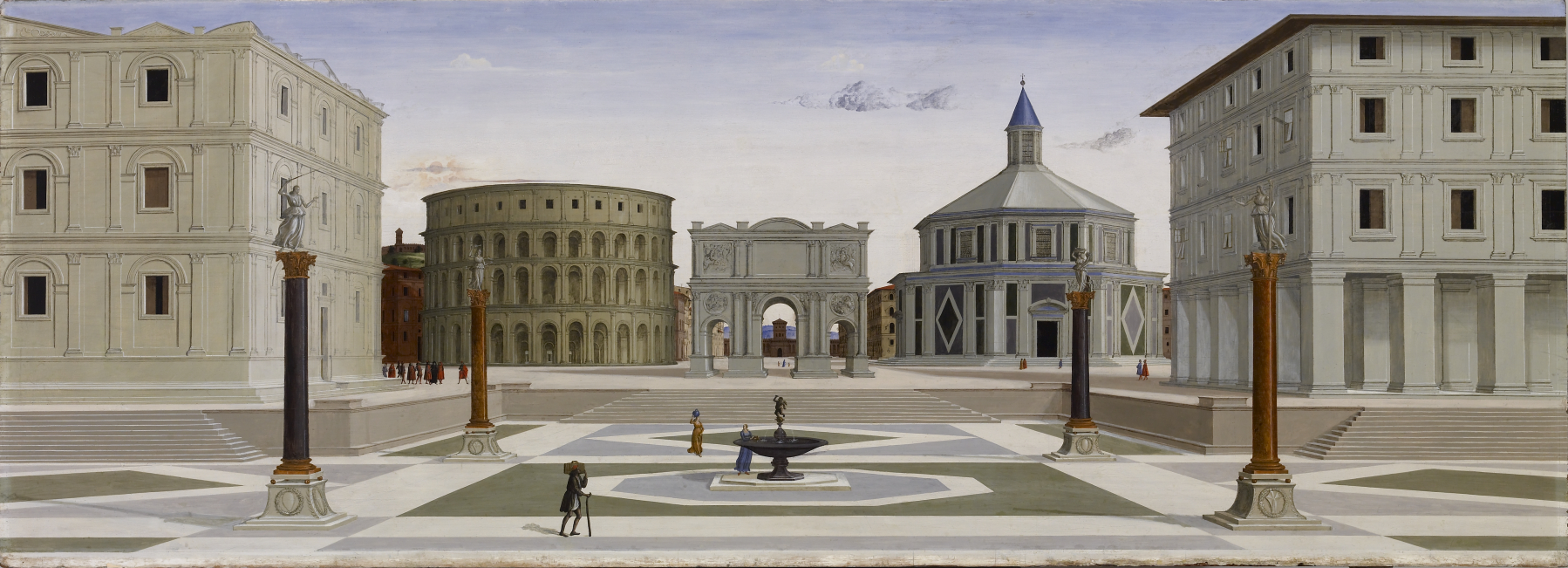
There is a painting called "The Ideal City" Painted by Fra Carnavale near the end of the 1400s.  This painting makes efficient use of linear perspective, a technique developed during the Renaissance.  This painting doesn't depict a real city, but a real structure stands out.  That structure is the hexagonal building to the right of the central Triumphal Arch.

This building is based off of one in central Florence.  That building is the Baptistry.  It sits in front of Florence's largest and most recognizable landmark, The Big Red Dome of the Cattedrale di Santa Maria del Fiore, better known as Il Duomo.  This is a structure whose doors were characterized by Michelangelo to be "The Gates of Paradise".  There's a whole history behind this building, really even just the history of the doors is interesting and I'm really tempted to write a bit on them.  But that will have to wait for another post, as this one needs to be kept short(er).

The point that I'm really getting at is Florence really is an ideal city.  Granted, there are a lot of tourists in this city, and it's a bit more expensive than the others I've been to in Italy, but it's beautiful.  Nearly every building is laid out in a similar plan.  Stores on the bottom floor, so you can just walk right up and shop, or buy food.  Apartments sit on the next two or three floors, and then there's a roof.  There aren't too many tall buildings in the city, unlike the US where twenty something story buildings aren't uncommon.  That means you don't need to throw out your back trying to look at the sky.  You can see major landmarks a long ways off, and the city itself isn't intimidating.  Moreover, all the buildings are made with similar materials.  They are almost all plaster-on-brick neoclassical style apartments with terracotta roofs. The streets of central Florence are highly walkable.  There aren't too many cars to worry about. You move slower, but that only makes it so you see the details of the ideal city better. 

But enough gushing over Florence in general.  I had a pretty busy day, and it was different from other days in that we didn't have any guides for the places we were visiting.  Normally the group is led around and told about what we were seeing.  Today, for better or for worse, we were basically on our own.

We started the tours of the day in the Palazzo Vecchio.  The building, a symbol of the Florentine Republic, but was transformed into a royal palace when Cosimo I became Grand Duke of Tuscany.  Outside the palace there are two very famous statues.  A copy of "David" by Michelangelo, and the bronze statue of "Perseus with the Head of Medusa".
The David (Copy) Original by Michelangelo
Perseus with the Head of Medusa by Benvenuto Cellini

Inside the palace is a museum which houses some beautiful paintings by Vasari, the famed painter and architect of the Medici. There are several rooms with several frescoes.  One set celebrates women from history, like Penelope in the Odyssey, and the Sabine women in the battles following their abduction.  After that I climbed to the top of Il Duomo.  It took several hundred steps up a narrow passage and spiral stairs, but I don't think anything can compare to the view at the top, plus a close up view of the painted ceiling depicting the triumph of Christ over the forces of hell. The painting of the figures at the top of the dome look at though they are stepping right out of the painting, like they are about to fall right into the church. One could spend hours studying all the details of this painting.

As I said, the view from the top is amazing.

I also climbed Giotto's Bell tower, and that was pretty underwhelming compared to the dome.  The massive bells inside were neat though. The largest bell is over 15 tons in weight.  The Duomo museum was more interesting.  It was a very modern museum, with a free app I installed on my phone, and used it as a guide around the museum.  It housed some impressive sculptures, plans for the redesign of the facade from the 1860s and some neat relics, like the chains of St. Peter.  The museum also had one of Michelangelo's unfinished sculptures, the "Florentine Pieta", often called "The Deposition".  It was damaged by Michelangelo in a fit of rage, but was later restored.  This Pieta is obviously not as famous as the one that sits in St. Peter's Basilica, but it has it's own history and it's worth seeing while in Florence.

The last building I toured was the Florentine Baptistry, the building with which I started this post.  It was an interesting structure.  The floor was a marble-mosaic with designs of waves, and squares made up of four dark and light triangles to make a bow-tie pattern.  The ceiling was a gold and tile mosaic which depicted Christ triumphal over the forces of Hell, as in the image on the inside of the dome.  Strangely enough these two buildings have been the only places where I have seen images of Jesus and demons of the underworld in the same image.  Florence must really like evoking Dante's vision of Hell.

I finished the day with a group dinner near the Capelle Medici.  It was a multi-course meal with potato-filled ravioli topped with a meat sauce, and a second course of pork with gravy and roasted potatoes.  Dessert was tiramisu.  All in all, not bad for a last day in Florence.

Thursday, May 26, 2016

Introduzione


Ciao!  I've decided to start a blog to document my time in Italy.  This is partly as a keepsake of my thoughts and misadventures through the lands of Caesar, and the stomping grounds of the Medici.  It's also for my family and friends, who I think would appreciate reading up on a daily updated narrative about my time in Italy.  And if I could a way to handle an assignment, for the class which I owe coming to Italy, then more power to me.

I've already been to Rome, Herculaneum (around the Naples area),  and I'm just finishing up my time in Italy.  So, I won't be able to document all the happens when it happens.  That's just how things work when you get an idea to do something too late.  But I'm also determined to turn this obstacle into an opportunity.  I'm going to have two different "types" of posts on this blog.  A daily post to cover the events of the day.  And every now and then I'll post retrospectives on certain days, and these will allow me to do a more researched blog post with a semblance of a narrative.

There will be another post today, because I'd like to get started with the daily posts ASAP, but I'd also like to use this opportunity to give a little introduction.

I'm going to Northeastern University, transitioning to my 4th year (it's a 5 year program with some time thrown in for a few 6-month Coops)  The program I am travelling to Italy on is called a Dialogue of Civilizations.  And I am studying "Science and Culture Through the Ages".  That not only means that I'll be looking at the science of ancient Rome, or the Renaissance, but also the modern stuff.  I've already been to a neutrino observation facility and a nuclear fusion reactor.  There really is a lot to look at. with regards to Science old and new in Italy.  And though I'm an introverted Engineer, I'm really loving learning about the culture.

I'm here with 23 other students, for a total of 24 including myself.  That leads to a breakdown of 16 guys and 8 girls, which is frankly a pretty good gender split in the world of engineering.  The class is taught by Cary Rappaport, who specializes in electro-magnetics and ground scanning radar and Lauren Pouchak. And the trip is covering a lot of Italy.  We started in Rome, went to Abruzzi for a day trip, Naples area for a few days to climb Vesuvius and see ancient Roman ruins.  Now we are in Florence, and yesterday we took a day trip to Pisa, but we are leaving this city soon.  Tomorrow we are going to Parma, where we'll stay a couple of nights, we also stop by Bologna before going up to Milan, later Turin, and we wrap up in Venice.  In the end we'll be seeing what I consider to be a good cross-section of Italy.

All I can say is stay tuned.  Arrivederci!