
Sunset from Piazza Michelangelo
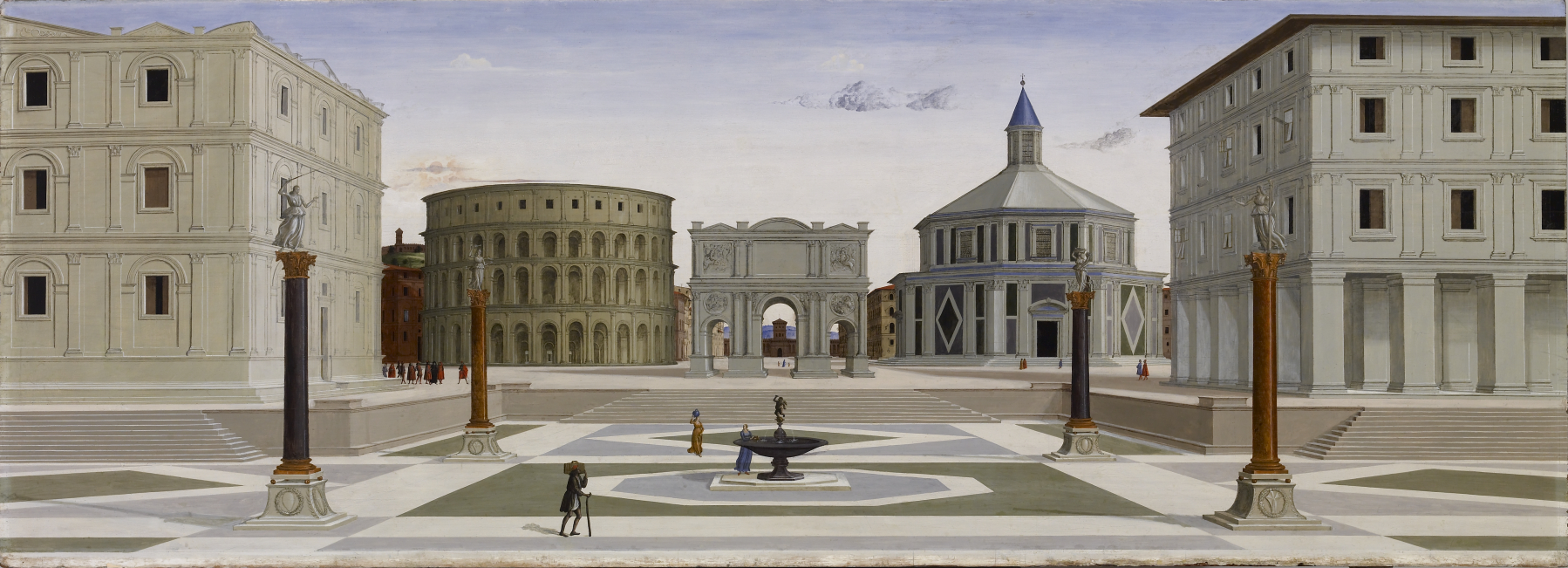 There is a painting called "The Ideal City" Painted by Fra Carnavale near the end of the 1400s. This painting makes efficient use of linear perspective, a technique developed during the Renaissance. This painting doesn't depict a real city, but a real structure stands out. That structure is the hexagonal building to the right of the central Triumphal Arch.
 This building is based off of one in central Florence. That building is the Baptistry. It sits in front of Florence's largest and most recognizable landmark, The Big Red Dome of the Cattedrale di Santa Maria del Fiore, better known as Il Duomo. This is a structure whose doors were characterized by Michelangelo to be "The Gates of Paradise". There's a whole history behind this building, really even just the history of the doors is interesting and I'm really tempted to write a bit on them. But that will have to wait for another post, as this one needs to be kept short(er).
The point that I'm really getting at is Florence really is an ideal city. Granted, there are a lot of tourists in this city, and it's a bit more expensive than the others I've been to in Italy, but it's beautiful. Nearly every building is laid out in a similar plan. Stores on the bottom floor, so you can just walk right up and shop, or buy food. Apartments sit on the next two or three floors, and then there's a roof. There aren't too many tall buildings in the city, unlike the US where twenty something story buildings aren't uncommon. That means you don't need to throw out your back trying to look at the sky. You can see major landmarks a long ways off, and the city itself isn't intimidating. Moreover, all the buildings are made with similar materials. They are almost all plaster-on-brick neoclassical style apartments with terracotta roofs. The streets of central Florence are highly walkable. There aren't too many cars to worry about. You move slower, but that only makes it so you see the details of the ideal city better.
But enough gushing over Florence in general. I had a pretty busy day, and it was different from other days in that we didn't have any guides for the places we were visiting. Normally the group is led around and told about what we were seeing. Today, for better or for worse, we were basically on our own.
We started the tours of the day in the Palazzo Vecchio. The building, a symbol of the Florentine Republic, but was transformed into a royal palace when Cosimo I became Grand Duke of Tuscany. Outside the palace there are two very famous statues. A copy of "David" by Michelangelo, and the bronze statue of "Perseus with the Head of Medusa".
 |
| The David (Copy) Original by Michelangelo |
 |
| Perseus with the Head of Medusa by Benvenuto Cellini |
Inside the palace is a museum which houses some beautiful paintings by Vasari, the famed painter and architect of the Medici. There are several rooms with several frescoes. One set celebrates women from history, like Penelope in the Odyssey, and the Sabine women in the battles following their abduction. After that I climbed to the top of Il Duomo. It took several hundred steps up a narrow passage and spiral stairs, but I don't think anything can compare to the view at the top, plus a close up view of the painted ceiling depicting the triumph of Christ over the forces of hell. The painting of the figures at the top of the dome look at though they are stepping right out of the painting, like they are about to fall right into the church. One could spend hours studying all the details of this painting.

As I said, the view from the top is amazing.

I also climbed Giotto's Bell tower, and that was pretty underwhelming compared to the dome. The massive bells inside were neat though. The largest bell is over 15 tons in weight. The Duomo museum was more interesting. It was a very modern museum, with a free app I installed on my phone, and used it as a guide around the museum. It housed some impressive sculptures, plans for the redesign of the facade from the 1860s and some neat relics, like the chains of St. Peter. The museum also had one of Michelangelo's unfinished sculptures, the "Florentine Pieta", often called "The Deposition". It was damaged by Michelangelo in a fit of rage, but was later restored. This Pieta is obviously not as famous as the one that sits in St. Peter's Basilica, but it has it's own history and it's worth seeing while in Florence.
 The last building I toured was the Florentine Baptistry, the building with which I started this post. It was an interesting structure. The floor was a marble-mosaic with designs of waves, and squares made up of four dark and light triangles to make a bow-tie pattern. The ceiling was a gold and tile mosaic which depicted Christ triumphal over the forces of Hell, as in the image on the inside of the dome. Strangely enough these two buildings have been the only places where I have seen images of Jesus and demons of the underworld in the same image. Florence must really like evoking Dante's vision of Hell.
I finished the day with a group dinner near the Capelle Medici. It was a multi-course meal with potato-filled ravioli topped with a meat sauce, and a second course of pork with gravy and roasted potatoes. Dessert was tiramisu. All in all, not bad for a last day in Florence.

The dome looks amazing.
ReplyDeleteThe dome was amazing. Though it really holds nothing next to the Sistine chapel. I'd like to write a post on that soon.
ReplyDelete